
|
|
GEOTECHNICAL
What is a Triaxial cell.

This is a very basic Triaxial Cell. Today's cells are much more sophisticated. The pressures are measured with pressure transducers, and differential transducers. The loads measured with load cells and the displacements with LVDs ( linear variable transformers). All the readings are fed into a computer and the adjustments are made with interfaces. Loads can be static, dynamic or both. Pressure is maintained with compressed air and diffusion coil to the cell. Soil samples can vary, standard is 25mm by 50mm long. The one I built for Japan was a mini Triaxial cell, 22.6 mm by 45mm, see specs and picture at the bottom.
When a soil sample is removed from a soil mass, all of the horizontal and vertical stresses acting on the soil in situ are removed. Thus, when the soil is tested in the laboratory to determine its strength, the test should be conducted under test conditions that resemble the field conditions as closely as possible. The triaxial compression test is a procedure that permits different horizontal and vertical stresses to be applied to the soil specimen simultaneously and thus closely duplicate the expected field conditions.
The concept of the triaxial compression test is that an all-around equal pressure is applied to the soil sample in the form of a confining pressure. The confining pressure,
sc, is obtained by imposing a compressive stress on a fluid that completely surrounds the soil specimen. The fluid most commonly used is water. Compressed air is also frequently used. If the principal axes, as shown in Figure above, are labeled 1, 2, and 3, instead of the conventional x, z, and y axes, respectively, the stresses acting on the specimen would be s2 and s 3 in the two horizontal directions. But since the confining pressure, sc, is an all-around pressure, thens
c = s 1 = s 2 = s 3Usually, the principal change in stress experienced by a soil mass is a change in
vertical stress due to the construction of a building, highway, airport, bridge, dam, or other structure on the surface above the supporting soil. Consequently, it would be logical to test the soil specimen in a configuration that permits the specimen to be placed in the testing device and loaded in a manner that duplicates what will happen in the field. Thus, most soil specimens are tested in the triaxial test by applying a vertical loading to the specimen. This is the arrangement depicted in figure above.Mini Triaxial at the University of Osaka Japan
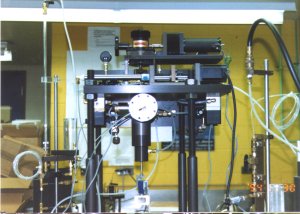
Top part
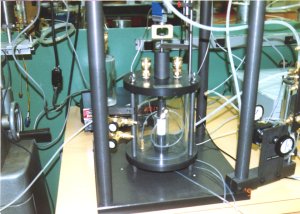
bottom part
This cell was specially designed to test soil from the Osaka Bay. The soil was tested for a suspension bridge that spans the bay.
Capacity of the New Mini Triaxial Test Apparatus
|
1. Specimen size Æ 22.6mm x h45.0mm |
|
2. Maximum value Cell pressure ............10.0 kgf/cm2 Back pressure ..........5.0 kgf/cm2 Axial load .................50 kgf Cyclic load ...............20 kgf Axial displacement.. 1.0 cm Volume change ........5.0 cm3 |
|
3. Resolution Axial strain ............10-4 (10-2 %)Volumetric strain ..10-4 (10-2 %) |

